


An expense ratio is a fee that mutual funds charge for managing your investments. This fee represents a percentage of the scheme's Assets Under Management (AUM).
How expense ratio works
The Asset Management Company (AMC) charges the expense ratio before announcing the daily Net Asset Value (NAV). The company deducts this fee from the NAV before declaring the daily price. The expense ratio for each scheme is published monthly as part of the factsheet on the respective AMC's website. You can also find the expense ratio of any mutual fund scheme on Coin.
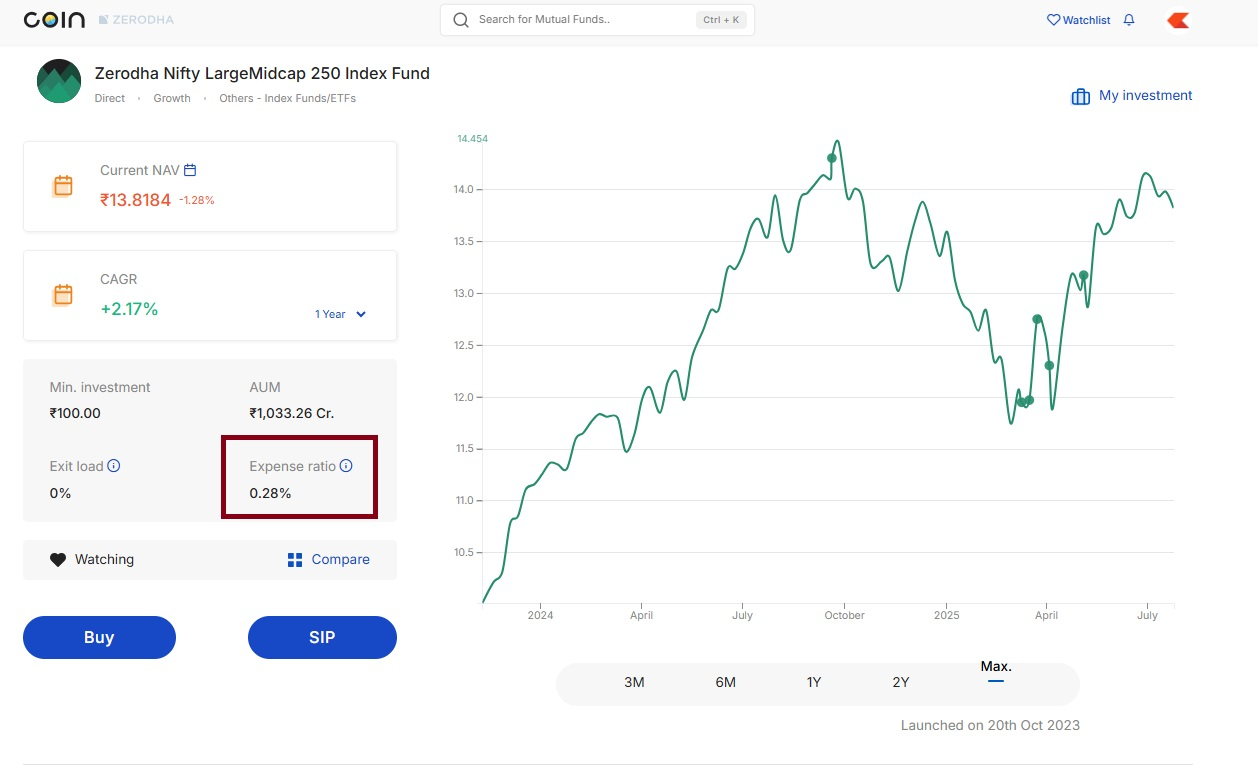
Why the expense ratio on Coin may differ from the AMC's TER
The Total Expense Ratio (TER) is the complete cost of managing a mutual fund scheme, expressed as a percentage of its Assets Under Management (AUM). It includes the Base Expense Ratio, brokerage cost, transaction cost, statutory levies and GST.
The expense ratio shown on Coin is the Base Expense Ratio (BER), not the TER. BER doesn't include some of these additional charges, so it's usually lower than the TER reported by the AMC.
This is why you may notice a difference between the expense ratio on Coin and the TER reported by the AMC. Both figures are accurate they just measure different sets of charges.
To check the TER for your mutual fund or SIF scheme, refer to:
- Mutual fund TER: https://www.amfiindia.com/ter-of-mf-schemes
- SIF TER: https://www.amfiindia.com/sif/ter-of-sif
Did you know? Direct and regular plans under the same scheme have different expense ratios. Direct plans charge lower expense ratios compared to regular plans.