


Currency derivatives are F&O contracts traded on exchanges, similar to stock F&O contracts. However, the underlying assets of these contracts are currency pairs such as USDINR, EURINR, JPYINR, or GBPINR, rather than stocks.
The lot size in currency contracts on stock exchanges represents the standardised quantity of currency units that can be traded within a single contract. It signifies the minimum amount of a specific currency eligible for trading in a single transaction. The contract specification of the Currency contracts can be found on the NSE website (WEB).
Lot sizes for currency pairs
| Contract | Lot size |
| USDINR | 1 unit denotes 1000 $ (Dollar) |
| EURINR | 1 unit denotes 1000 € (Euro) |
| GBPINR | 1 unit denotes 1000 £ (Pound sterling) |
| JPYINR | 1 unit denotes 100,000 ¥ (Yen) |
Example Scenario
- Suppose we take the USD-INR currency pair with a lot size of 1,000.
- To buy or sell USD-INR contracts, traders must transact in multiples of 1,000 units.
- If a trader buys one lot, they would be purchasing 1,000 units of the U.S. Dollar against the Indian Rupee.
-
Likewise, if a trader sells one lot, they would be selling 1,000 units of the U.S. Dollar against the Indian Rupee.
To learn more, visit zerodha.com/varsity/chapter/the-usd-inr-pair.
Available instruments on NSE currency derivatives segment
You can trade these instruments:
-
Currency F&O on 4 currency pairs (USDINR, EURINR, JPYINR, and GBPINR)
- Interest rate F&O on Government Securities (G-Secs)
- 91-Day Treasury-Bills (T-bills)
- Overnight MIBOR (ONMIBOR)
How to trade currency derivatives on Kite
Currency F&O can be traded by adding them to the marketwatch on Kite. To add these contracts, type out the name of the currency pair in the universal search on Kite, and all the contracts will be displayed in the drop-down.
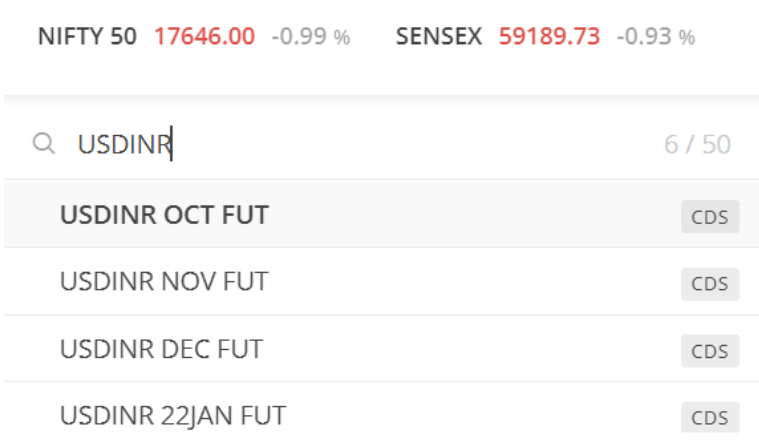
Hover over the contract to be traded and click or tap on
Buy
or
Sell
to place an order.
Did you know? Currency derivative contracts are settled at the RBI reference rate.