


Short delivery happens when a seller fails to deliver shares by the settlement date. This can occur in three situations:
- You take an intraday short position and cannot close it because the stock hits the upper circuit.
- You sell shares in a Buy Today, Sell Tomorrow (BTST) transaction before they are credited to your demat account.
- You hold open futures or in-the-money options at expiry that require physical delivery, but you do not have the necessary shares. In this case, you can get the shares transferred from another demat to your Zerodha demat on the same day (T day) to avoid the shares going into auction.
The consequences differ depending on whether you are the buyer or the seller.
For buyers
How to check if my shares have been short-delivered?
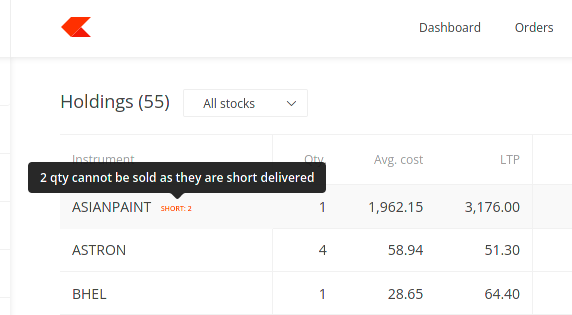
You receive email and Kite notifications when short delivery happens. A short-delivery tag also appears beside the affected stock.
- On Kite app: the short-delivered quantity displays for the stock.

- On Kite web: Hovering over the tag displays the short-delivered quantity.
When will I receive shares after short delivery?
You will receive your shares on T+2 day. The Clearing Corporation holds a voluntary auction on T+1 day to procure the short-delivered shares. If the Clearing Corporation cannot procure shares in the auction, your Zerodha account will be credited with cash based on the close-out price.
Example:
- You purchase shares on Monday (T day), and they appear as T1 holdings until Tuesday (T+1 day)
- If shares were not delivered on Tuesday (T+1 day), a short delivery tag appears on Wednesday (T+2 day)
- The exchange delivers shares procured from the auction market held on Tuesday (T+1 day) and delivers them on Wednesday (T+2 day)
- You can see the shares on Kite from Thursday (T+3 day)
For sellers
If the stock is already held in your demat account, the delivery obligation can be settled directly from those holdings, and the shares will be debited towards the delivery obligation.
However, if you are a non-DDPI/POA account holder and do not authorise the sale of securities, the delivery of shares will fail. In such cases, the shares are temporarily blocked and may not be visible in your Kite holdings. These shares will be unblocked after market hours on Expiry + 1 day.
When you fail to deliver shares by the settlement date, the Clearing Corporation (CC) conducts a voluntary auction on T+1 day, usually after 2:30 PM, lasting 30 minutes. Bidding occurs within a price band typically set at ±20% of the previous day's settlement price.
Zerodha blocks a 120% short delivery margin based on the settlement price on T day to cover potential auction costs. Zerodha reverses this margin once the auction is completed.
Example :
- Monday (T day): You sell 100 shares at ₹800 per share.
- Tuesday (T+1 day): You do not have the shares in your demat account, causing a short delivery. The exchange holds an auction. The price band is ±20% of Monday's settlement price. If Monday's price was ₹830, the auction range is ₹664 to ₹996.
- Wednesday (T+2 day): If the exchange buys the shares at ₹920, your account is debited the total cost (auction price and charges).
Types of shortages and their charges
The charges you pay depend on whether the shortage is internal or exchange-based.
Internal shortage occurs when both the buyer and seller are clients of the same broker. If you fail to deliver shares, the buyer within Zerodha does not receive them.
Charges:
-
Auction facilitation fee: The Clearing Corporation charges 1% of the security's value (price on the day prior to auction multiplied by quantity), plus 18% GST.
Example:
- Settlement price = ₹1,000
- Quantity = 100 shares
- Value of security = ₹1,00,000 (₹1,000 × 100)
- Facilitation fee = ₹1,000 (1% of ₹1,00,000)
- GST = ₹180 (18% of ₹1,000)
- Total auction fee = ₹1,180 (Fee + GST)
Exchange shortage occurs when the buyer and seller are with different brokers. If you fail to deliver shares to Zerodha, Zerodha defaults on the delivery to the Clearing Corporation.
Charges:
-
Auction or shortage penalty: The Clearing Corporation charges 0.05% of the security's value (price on the day prior to auction multiplied by quantity), plus 18% GST.
Example:
-
Settlement price = ₹1,000
-
Quantity = 100 shares
-
Value of security = ₹1,00,000 (₹1,000 × 100)
-
Penalty (0.05%) = ₹50 (0.05% of ₹1,00,000)
-
GST (18%) = ₹9 (18% of ₹50)
-
Total penalty = ₹59 (Penalty + GST)
Auction price for unsuccessful shortages
As per the exchange circular, if the exchange cannot buy all the required shares in an auction, it uses a Weighted Average Price (WAP) for auction settlement.
Example scenario:
There is a shortage of 1,000 shares. The exchange tries to buy them in an auction, but only finds some:
- 800 shares are bought at ₹100 (auction price).
- 200 shares could not be bought, so they are closed out at ₹120 (closeout price).
How the Weighted Average Price (WAP) is calculated:
Instead of charging two different prices, the exchange blends them into one:
- (800 shares × ₹100) + (200 shares × ₹120) = ₹1,04,000 (total cost)
- ₹1,04,000 ÷ 1,000 shares = ₹104 per share (WAP)
The final settlement:
- For you (the seller): Your account is debited at a flat rate of ₹104 per share for the entire 1,000 shares (total: ₹1,04,000).
- For the buyer: They receive the 800 shares that were bought, plus a cash credit of ₹120 per share for the 200 shares that were not available in the auction.
If no shares are purchased in the auction, the closeout price (₹120) applies to the full 1,000 shares for both the buyer and the seller.
The Investor Protection Fund (IPF)
If the exchange buys shares in the auction at a lower price than the T-day settlement price, the exchange collects the price difference and transfers it directly to the Investor Protection Fund (IPF).