


As a resident Indian, you can invest in up to 2,000 US-listed stocks and around 1,000 Exchange Traded Funds (ETFs) through Zerodha's Global stocks segment, without opening a separate account. This guide covers everything from activating the segment and transferring funds to tax rules, compliance obligations, and Income Tax Return (ITR) filing requirements for Indian investors in US stocks.
Index
- Getting started
- Funds and transfers
- Exchange rate and conversion charges
- The Liberalised Remittance Scheme (LRS): Rules and limits
- TCS on remittances
- Orders and trading
- Holdings, P&L, and reports
- Tax on your returns
- Compliance and filing
- Account management
Getting started
You can invest in US stocks through Zerodha if you are a resident Indian with an individual account. Joint accounts and non-individual entities, such as Hindu Undivided Families (HUFs), companies, Limited Liability Partnerships (LLPs), and partnership firms, are currently not supported. Non-Resident Indians (NRIs) are also not eligible.
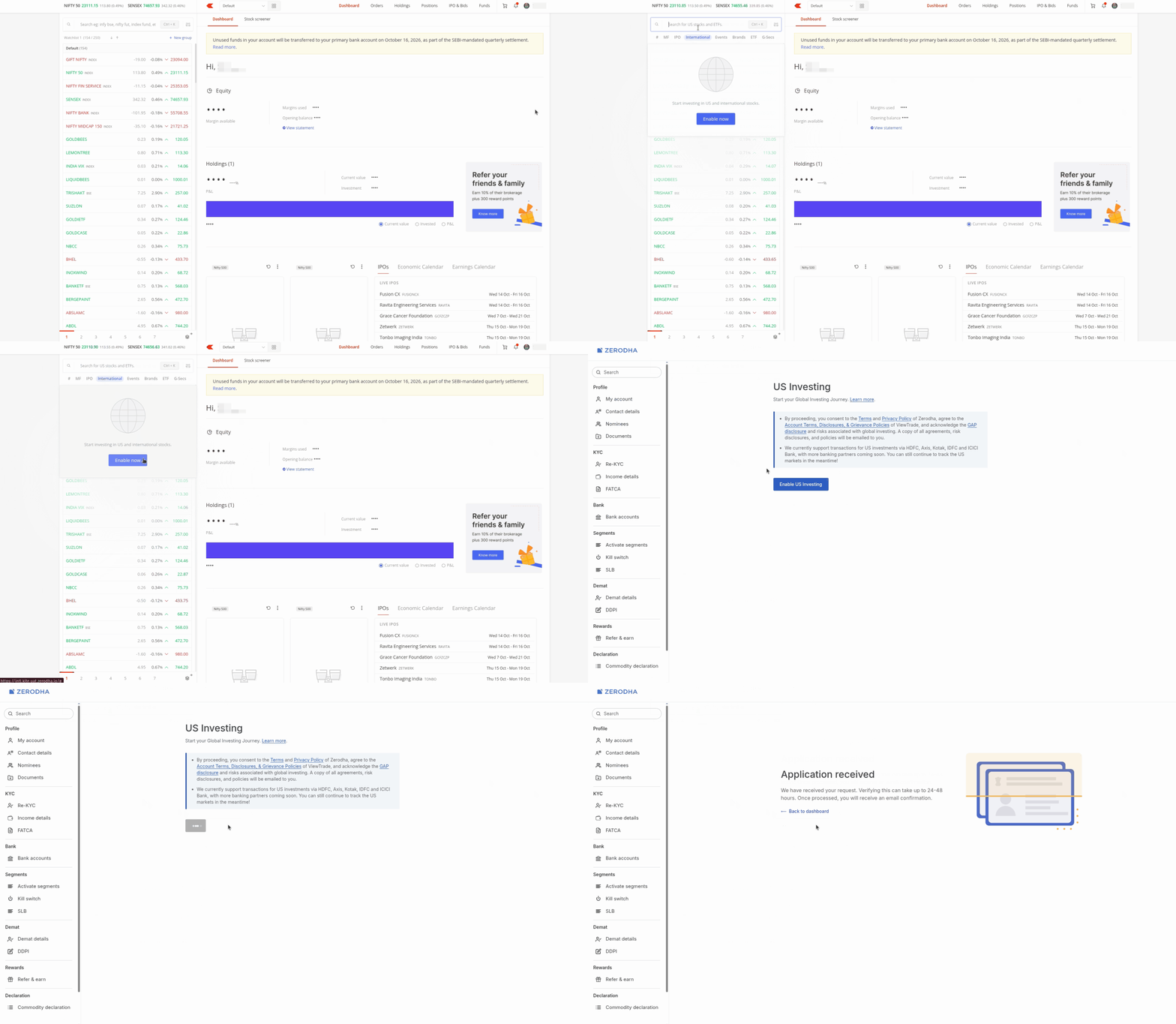
You can activate your Zerodha account for US investing by visiting account.zerodha.com and clicking Enable US investing. You do not need to open a separate demat account or complete physical paperwork.
You can also activate the segment via Kite by following these steps:
- Login to Kite.
- Click on International from Marketwatch, Holdings, or Funds page.
- Click on Enable now.
- Click on Enable US investing.
Once your activation request has been submitted. The process takes up to 48 working hours, and an email confirmation will be sent to your registered email once it is ready.
Zerodha routes these investments through BSE’s India INX Global Access at GIFT City IFSC. There is no physical paperwork and no need to open a separate demat account.
Before activating the segment, ensure that your Aadhaar is linked to your mobile number. If it is not, complete your re-KYC through account.zerodha.com first. Unlike the Futures and Options (F&O) segment, income proof is not required to activate the US stocks segment. To learn more, see How to activate the US stocks segment on Zerodha?
Eligible investments, market data, and fractional units
Once activated, you can invest in:
- Up to 2,000 of the largest US-listed companies by market capitalisation.
- Around 1,000 Exchange Traded Funds (ETFs) with Assets Under Management (AUM) exceeding $250 million. ETFs below this threshold are not available.
- Bitcoin ETFs and leveraged ETFs are not available, even if they meet the AUM requirement.
We are starting with these offerings and plan to slowly enable more stocks, ETFs, and other global exchanges in the future.
All US stocks in your MarketWatch are displayed with an INTL tag so you can identify them at a glance. In the market depth view, you can check key numbers such as Open, High, Low, Close (OHLC), volume, and Last Traded Time (LTT). Bid and offer quotes are not available currently, though Zerodha is exploring ways to introduce them in the future. You can also view chart data across different timeframes for both intraday and daily analysis, and access a comprehensive Fundamental widget tailored for US stocks, similar to Indian equities.
High stock prices are not an obstacle to investing in the US market because you do not have to buy a full share. Through fractional investing, you can buy a portion of an eligible stock or ETF using exact dollar amounts. For example, if a stock costs $300 and you want to invest $75, you buy exactly 0.25 shares. Your profits, losses, and dividends scale automatically with the fraction you own.
Unsupported products and features
- US IPO applications are not supported. You can invest only after the stock is listed and meets Zerodha's eligibility criteria.
- Only delivery (CNC) orders are supported. Intraday (MIS) trading and Margin Trading Facility (MTF) are not available.
- Securities Lending and Borrowing (SLB) for US stocks is currently not available.
Funds and transfers
Adding funds
Before you can buy US stocks, you must transfer money from your registered Indian bank account to your Global wallet.
The Global wallet is a USD wallet linked to your US stocks segment. Money added to the wallet is used to purchase US stocks, and the proceeds from selling them are credited back to the wallet. You can withdraw the available balance to your registered bank account whenever required.
To add funds:
- Go to Funds on Kite.
- Select Global stocks.
- Complete the transfer using netbanking from your linked bank account.
 Transfers initiated before 2:30 PM IST reach your Global wallet within 2 working days. Transfers initiated after 2:30 PM IST take up to 3 working days.
Currently, only netbanking is supported. Unified Payments Interface (UPI), debit cards, and credit cards cannot be used.
The following partner banks are currently supported:
- HDFC Bank
- ICICI Bank
- IDFC FIRST Bank
- Axis Bank
- Kotak Mahindra Bank
Charges apply when adding funds to and withdrawing funds from your Global wallet.
Transaction limits
Transaction limits are set by partner banks and apply across all five supported banks:
- Minimum amount per transaction: USD 50 for your first transfer, and USD 100 for subsequent transfers.
- Bank-wise transaction limits:
| Bank | Minimum limit | Maximum limit |
|---|---|---|
| HDFC Bank | USD 50 | USD 50,000 |
| ICICI Bank | USD 50 | USD 100,000 |
| IDFC FIRST Bank | USD 50 | USD 25,000 |
| Axis Bank | USD 50 | USD 45,000 |
| Kotak Mahindra Bank | USD 50 | USD 50,000 |
The USD 50 minimum applies to your first transfer. All following transfers require a minimum of USD 100.
Withdrawing funds
To withdraw money from your Global wallet:
- Go to the Global stocks funds section on Console.
- Submit a withdrawal request.
Withdrawal requests submitted before 1:30 PM IST are processed on the same working day. Requests submitted after 1:30 PM IST are processed on the next working day. Once processed, the funds are credited to your registered bank account within one working day.
You can keep uninvested funds in your Global wallet for up to 180 days. After this period, the balance is subject to quarterly settlement requirements.
Exchange rate and conversion charges
When you add funds to your Global wallet, your bank converts your Indian Rupees (INR) into US Dollars (USD). Instead of using the Reserve Bank of India (RBI) reference exchange rate directly, banks apply a small markup over it while converting your money.
Zerodha has negotiated a currency conversion markup of 0.5 to 1.2% above the RBI reference rate.
Apart from the exchange rate markup, your bank may also charge:
- Goods and Services Tax (GST) of 18% on the currency conversion fee.
- A wire transfer (remittance) fee for processing the overseas transfer.
These are bank charges and cannot be claimed back while filing your Income Tax Return (ITR). This is different from Tax Collected at Source (TCS), which is explained later in this article. TCS is not an additional tax and can be claimed as a tax credit while filing your ITR.
SBI TT buying rate
The State Bank of India (SBI) Telegraphic Transfer (TT) buying rate is the exchange rate prescribed under the Income Tax Rules for converting foreign currency into Indian Rupees (INR) for certain tax calculations. This rate is different from the exchange rate your bank uses when converting your money into USD.
- Your bank's exchange rate is used only when you transfer money to your Global wallet.
- The SBI TT buying rate is used only for tax calculations, such as converting your purchase cost, sale proceeds, or dividend income from USD to INR while calculating your taxable income.
The Liberalised Remittance Scheme (LRS): Rules and limits
Every time you transfer money from India to your Global wallet, the transfer is made under the Liberalised Remittance Scheme (LRS), a framework introduced by the Reserve Bank of India (RBI) under the Foreign Exchange Management Act (FEMA). LRS allows resident Indians to send money abroad for permitted purposes, including investing in foreign stocks.
Under LRS, you can remit up to $250,000 in a financial year (1 April to 31 March). This limit applies to all LRS transactions combined, not just investments in US stocks.
For example, if you remit money during the same financial year for overseas education, foreign travel, gifts, or US stock investments, the total of all these remittances cannot exceed $250,000 without prior RBI approval.
The limit is calculated per individual and tracked against your Permanent Account Number (PAN) across all banks. It is not linked to a specific bank account.
For example, if you remit:
- $100,000 through HDFC Bank, and
- $150,000 through ICICI Bank,
Even though the remittances are made through different banks, they are both reported against the same PAN. As a result, you will have exhausted your annual LRS limit.
Since the limit is per individual, each eligible family member has a separate annual limit. For example, a family of four with two parents and two adult children can collectively remit up to $1 million in a financial year, provided each person makes the remittance from their own account under their own PAN.
There is no limit on the number of transactions you can make. Only the total amount remitted during the financial year is considered.
For most remittances, you cannot exceed the $250,000 limit without prior RBI approval. However, higher limits may be permitted for certain purposes, such as overseas education, overseas medical treatment, or emigration, if supported by the required documents.
When you remit money to invest in US stocks, your bank reports the transaction using the purpose code S0001 (Overseas Equity Investment). Providing your PAN is mandatory for every LRS transaction.
What LRS permits
LRS allows you to remit money abroad for purposes such as:
- Investing in overseas stocks, Exchange Traded Funds (ETFs), and other permitted foreign securities.
- Overseas education.
- Overseas travel.
- Overseas medical treatment.
- Maintaining close relatives living abroad.
- Making gifts or donations to non-residents.
- Maintaining a foreign currency account with an overseas bank.
- Investing in products offered through an International Financial Services Centre (IFSC), such as GIFT City.
What LRS does not permit
LRS cannot be used for:
- Margin trading or leveraged investing in foreign markets.
- Purchasing foreign lottery tickets or participating in sweepstakes.
- Speculative foreign currency trading.
- Purchasing Foreign Currency Convertible Bonds (FCCBs) issued by Indian companies in the overseas secondary market.
- Remittances to countries identified as non-cooperative by the Financial Action Task Force (FATF).
- Investments or transactions specifically prohibited under FEMA or RBI regulations.
You also cannot remit money under LRS and then transfer it as a gift to another person residing outside India to help them utilise your annual remittance limit. RBI specifically prohibits this.
Violating the conditions of LRS is treated as a violation under FEMA. Depending on the nature of the violation, penalties may include fines and seizure of the remitted amount.
Each time you add funds to your Global wallet, your bank processes a Form A2 declaration and reports the remittance to the RBI. This reporting is also used to determine whether Tax Collected at Source (TCS) applies once your cumulative remittances exceed the prescribed threshold.
TCS on remittances
Tax Collected at Source (TCS) is a tax collected by your bank when you remit money abroad under LRS.
For investments in US stocks, TCS applies only after your total LRS remittances during a financial year exceed ₹10 lakh. Remittances up to ₹10 lakh do not attract TCS. This threshold is cumulative across all LRS remittances, not just investments in US stocks.
For example, if during the same financial year you remit:
- ₹6 lakh for overseas travel, and
- ₹5 lakh for investing in US stocks,
Your total LRS remittances become ₹11 lakh. Since the combined remittances exceed ₹10 lakh, TCS applies to the applicable portion of your investment remittance.
The ₹10 lakh threshold was increased from ₹7 lakh to ₹10 lakh in Budget 2025 and has been effective since 1 April 2025.
TCS is not an additional tax or an extra cost. Instead, it works like advance tax. Your bank collects the tax and deposits it with the Income Tax Department on your behalf. When you file your Income Tax Return (ITR), you can claim the TCS as a tax credit against your total tax liability. If the TCS collected is more than your final tax liability, the excess amount is refunded by the Income Tax Department.
Ensure that your PAN is linked to your Aadhaar. If it is not, a higher TCS rate may apply under the Income Tax Act.
For remittances made to invest in US stocks, the applicable TCS rate is 20%.
Different LRS purposes have different TCS rates once the common ₹10 lakh threshold is crossed:
- Overseas education funded through a qualifying education loan does not attract TCS.
- Self-funded overseas education and overseas medical treatment attract TCS at 5%.
- Overseas tour packages attract TCS at 5% up to ₹10 lakh and 20% above that threshold.
- Overseas investments, including investments in US stocks, attract TCS at 20%.
Although the rates differ, all these remittances share the same ₹10 lakh annual threshold. This means remittances made for one purpose also count towards the threshold for the others.
Orders and trading
US market timings
You can place orders for US stocks at any time. However, they are executed only when the US market is open. Because US markets trade during Indian evening hours, your orders are processed as soon as the US market opens.
Market timings in India vary depending on whether the US observes Standard Time or Daylight Saving Time (DST):
- US Standard Time (November to March): 8:00 PM to 2:30 AM IST
- US Daylight Saving Time (March to November): 7:00 PM to 1:30 AM IST
During Daylight Saving Time, clocks in the US move forward by one hour. As a result, the US market opens and closes one hour earlier in Indian Standard Time (IST).
How to place an order on Kite
Placing an order on Kite for US stocks works much like buying Indian equities:
- Click on the search bar in MarketWatch and select International.
- Search for the US company or ETF you want to buy.
- Click on the + icon to add the instrument to your MarketWatch, or hover over the instrument and click on B (Buy) or S (Sell) to open the order window.
-
Choose whether to place your order by quantity or amount:
- To buy by amount: Click on Switch quantity/amount to switch from quantity to amount, and enter the exact dollar amount you want to invest. Kite automatically calculates the corresponding fraction of units for you without manual calculations.
- To buy by quantity: Enter the number of shares or fractional units you want to purchase.
- Check your margin: The order window displays available and required margins in both US Dollars and Indian Rupees, along with a toggle switch to flip between the dollar view and rupee value view.
- Select your order type ( Market or Limit ) and click on Buy to place your order.
Supported order types
US investing through Zerodha is strictly delivery-based. Intraday (MIS) and margin trading options are not available.
The following order types are supported:
- Market order: Executed immediately at the best available market price when the US market is open. Can be placed either by quantity or by amount.
- Limit order: Executed only at your specified limit price or a better price. Can be placed either by quantity or by amount.
Stop-loss (SL) orders will be introduced soon via Good Till Triggered (GTT). Same-day buy and sell trades are permitted.
Brokerage and regulatory charges
When you buy or sell US equities and ETFs, the following brokerage and statutory charges apply:
| Charge | Rate | Applicable side |
|---|---|---|
| Brokerage | 0.10% (Minimum $0.01, Maximum $10) | Buy and sell |
| Integrated Goods and Services Tax (IGST) | 18% on brokerage amount | Buy and sell |
| International Financial Services Centres Authority (IFSCA) turnover fee | 0.005% on trade value | Buy and sell |
| Securities and Exchange Commission (SEC) fee | 0.00206% on trade value | Sell only |
| Financial Industry Regulatory Authority (FINRA) fee | 0.0195% multiplied by sell quantity* | Sell only |
*The FINRA Trading Activity Fee (TAF) is paused from 1 October to 31 December.
A minimum charge of 1 cent ($0.01) applies to SEC, FINRA, and IFSCA fees.
Example calculation for a buy order
Suppose you buy 100 shares of a US stock at $90 per share:
| Component | Calculation | Amount |
|---|---|---|
| Gross trade value | 100 shares × $90 | $9,000.00 |
| Brokerage (0.10%) | 0.10% of $9,000 (subject to the $10 cap) | $9.00 |
| IGST (18%) | 18% of $9.00 | $1.62 |
| IFSCA turnover fee (0.005%) | 0.005% of $9,000 | $0.45 |
| Total charges | $9.00 + $1.62 + $0.45 | $11.07 |
| Net payable amount | $9,000.00 + $11.07 | $9,011.07 |
Example calculation for a sell order
Suppose you sell 100 shares of a US stock at $90 per share:
| Component | Calculation | Amount |
|---|---|---|
| Gross trade value | 100 shares × $90 | $9,000.00 |
| Brokerage (0.10%) | 0.10% of $9,000 (subject to the $10 cap) | $9.00 |
| IGST (18%) | 18% of $9.00 | $1.62 |
| IFSCA turnover fee (0.005%) | 0.005% of $9,000 | $0.45 |
| SEC fee (0.00206%) | 0.00206% of $9,000 (rounded to nearest cent) | $0.19 |
| FINRA fee | Paused from 1 October to 31 December | $0.00 |
| Total charges | $9.00 + $1.62 + $0.45 + $0.19 | $11.26 |
| Net receivable amount | $9,000.00 − $11.26 | $8,988.74 |
Tracking and modifying international orders
To keep track of your trading activity and avoid confusion with NSE and BSE trades, international orders are grouped in a separate section within your order book:
- The international section can be collapsed or expanded, and displays all open and completed international orders together in a single unified view.
- Full-quantity orders: Can be modified normally while in pending status.
- Fractional orders: Cannot be modified once submitted. To change a pending fractional order, cancel the existing order and place a new one.
Upcoming trading features
In upcoming releases, Zerodha plans to roll out additional tools for US stocks, including:
- Good Till Triggered (GTT) and Stop-loss (SL) orders
- Systematic Investment Plans (SIPs)
- Technical analysis tools
- Price alerts
- Basket orders
Settlement cycle
US stocks follow a T+1 settlement cycle. This means the settlement is completed one business day after the trade date.
For example, if you buy a US stock on Monday, the settlement is completed on Tuesday, provided it is a working day in the US.
Holdings, P&L, and reports
Viewing your holdings
Once executed, your investments reflect directly under the
International
tab on your Holdings page on Kite and Console, complete with a toggle to view their total INR value.

Key aspects of US stock holdings include:
- Direct holdings update: Same-day-purchased stocks update directly on the Holdings page without passing through the Positions tab.
- Immediate reflection: Unlike Indian equities that wait for settlement, US stocks appear under Holdings as soon as your order is executed.
- Sales adjustments: Any shares you sell are adjusted directly from your holdings.
- Custody and protection: US stocks are not held in your Indian demat account. Instead, they are held securely through Zerodha’s US broker partner (ViewTrade) on your behalf and protected by SIPC insurance up to $500,000. As a result, secondary transfers and gifting of US stocks are not supported.
Your overall portfolio value on Console includes both your Indian and US investments. You can view them together or separately.
How P&L is calculated
Profit and Loss (P&L) for US stocks is calculated using the First In, First Out (FIFO) method.
Under the FIFO method, the shares you buy first are treated as the first shares sold.
For example:
- You buy 10 shares in January.
- You buy another 10 shares in March.
- You sell 10 shares in June.
The 10 shares purchased in January are treated as the first shares sold when calculating your P&L.
Since intraday trading is not available for US stocks, there is no separate intraday P&L.
Under the P&L section on Console, you can view:
- Realised P&L from completed sales.
- Unrealised P&L on your current holdings.
- Applicable charges and taxes.
Dividends
Some US companies distribute a portion of their profits to shareholders as dividends.
When a dividend is paid, 25% tax is deducted in the US before the amount is credited to your account.
Every year, Zerodha provides Form 1042-S, a US tax statement that shows:
- The total dividend paid.
- The tax withheld in the US.
You will need this statement while filing your Income Tax Return (ITR) to claim credit for the tax already deducted in the US. The process is explained in the Tax on your returns section.
Corporate actions
Corporate actions, such as bonus issues, stock splits, mergers, and demergers, are tracked using a daily corporate actions file.
Whenever a corporate action affects your holdings, the required adjustments are made automatically, and your holdings are updated accordingly.
Downloading reports
You can download your US stock tradebook and P&L reports from the P&L and Reports sections on Console.
Tax on your returns
India and the United States have a Double Taxation Avoidance Agreement (DTAA), which ensures that the same income is not taxed twice. Under this agreement, capital gains from US stocks are taxable only in India for resident Indian investors. You do not pay capital gains tax in the US.
Dividends are treated differently. Tax is deducted in the US before the dividend is credited to your account. However, you can claim credit for this tax while filing your Income Tax Return (ITR) in India, so you do not pay tax twice on the same dividend income.
The DTAA applies only to income taxes. It does not cover the US estate tax, which is explained later in this section.
Capital gains: Long-Term Capital Gain (LTCG) and Short-Term Capital Gain (STCG)
The tax on your capital gains depends on how long you hold your investment before selling it.
US stocks qualify as long-term only if held for more than 24 months for Indian tax purposes, unlike Indian-listed equities, which qualify as long-term after being held for more than 12 months.
- Long-Term Capital Gain (LTCG): Applies if you sell a US stock after holding it for more than 24 months. The gain is taxed at 12.5%, plus applicable surcharge and cess.
- Short-Term Capital Gain (STCG): Applies if you sell a US stock within 24 months. The gain is added to your total income and taxed according to your applicable income tax slab.
The ₹1.25 lakh annual LTCG exemption available for Indian-listed equities does not apply to US stocks. Capital gains on US stocks are taxable from the first rupee.
Indexation benefits are also not available. Your capital gain is calculated as the difference between the purchase price and the sale price after converting both amounts to Indian Rupees (INR) using the applicable SBI TT buying rates.
Effective tax rates with cess and surcharge
The rates above are the base tax rates.
Your final tax liability may be higher because:
- Health and Education Cess of 4% is levied on the total tax payable.
- Surcharge may apply if your total income exceeds ₹50 lakh.
| Total income | Surcharge | Effective LTCG rate (including 4% cess) |
|---|---|---|
| Up to ₹50 lakh | Nil | ~13% |
| ₹50 lakh to ₹1 crore | 10% | ~14.3% |
| ₹1 crore to ₹2 crore | 15% | ~14.9% |
| Above ₹2 crore | 25% | ~16.3% |
How gains and dividends are converted to INR
For tax purposes, all amounts in US Dollars (USD) must be converted into INR using the SBI TT buying rate.
The applicable rate is the SBI TT buying rate published on the last day of the month immediately preceding the transaction.
Use:
- The SBI TT buying rate for the last day of the month before the purchase to determine the cost of acquisition.
- The SBI TT buying rate for the last day of the month before the sale to calculate the sale value.
- The SBI TT buying rate for the last day of the month before receiving a dividend to calculate dividend income.
Since different exchange rates are used for the purchase and sale, your taxable gain in INR may be different from your gain in USD.
Both the purchase price and the sale price must be converted separately using their respective SBI TT buying rates.
Example
Suppose you:
- Buy 20 shares in January 2023 at $50 per share.
- Sell all 20 shares in March 2025 at $80 per share.
Your gain is:
20 × ($80 − $50) = $600
Assume the SBI TT buying rate on 28 February 2025 (the last day of the month before the sale) is ₹84.
Your taxable gain is:
$600 × ₹84 = ₹50,400
Since the shares were held for more than 24 months, the gain is treated as LTCG. At the base tax rate of 12.5%, the tax is ₹6,300. Adding 4% Health and Education Cess brings the total tax payable to ₹6,552.
If the same shares had been sold before completing 24 months, the gain would have been treated as STCG and taxed according to your applicable income tax slab.
Dividends and the 25% withholding tax
When a US company pays a dividend, tax is deducted before the dividend is credited to your account.
Under the DTAA, the standard US withholding tax of 30% is reduced to 25% for eligible Indian residents, provided a valid Form W-8BEN is available for your account.
Form W-8BEN is a declaration that confirms you are not a US tax resident and allows you to claim the lower withholding tax rate under the DTAA.
The form remains valid for:
- The calendar year in which you submit it, and
- The following three calendar years.
It becomes invalid if you:
- Become a US citizen.
- Obtain a US Green Card.
- Spend more than 183 days in the US during a calendar year.
In these situations, you must submit a new Form W-8BEN if required.
The tax deducted in the US is not a permanent cost. While filing your ITR in India, you can claim it as a Foreign Tax Credit (FTC). This credit reduces the tax you pay in India on the same dividend income, ensuring you are not taxed twice.
The credit you can claim is limited to the lower of:
- The tax withheld in the US, or
- Your Indian tax liability on that dividend income.
To claim the credit, you must:
- File Form 67 before submitting your ITR.
- Report the credit in Schedule TR (Tax Relief) of your ITR.
Setting off capital losses and tax loss harvesting
If you sell a US stock at a loss, you can use that loss to reduce the tax payable on your capital gains. This strategy is commonly known as tax loss harvesting.
The set-off rules are the same as those for other capital assets in India:
- Short-term capital losses can be set off against both short-term and long-term capital gains.
- Long-term capital losses can be set off only against long-term capital gains.
If you cannot use the loss during the same financial year, you can carry it forward for up to eight assessment years.
To carry forward a capital loss, you must file your ITR before the due date, even if your income is below the taxable limit.
Advance tax
If your total tax liability during a financial year exceeds ₹10,000, you must pay advance tax in instalments instead of paying the entire amount at the end of the year.
Failure to pay advance tax on time may attract interest under Sections 234B and 234C of the Income Tax Act.
| Instalment | Due date | Minimum cumulative tax payable |
|---|---|---|
| First | 15 June | 15% |
| Second | 15 September | 45% |
| Third | 15 December | 75% |
| Fourth | 15 March | 100% |
Any TCS collected on your overseas remittances can be adjusted against your advance tax liability.
US estate tax
Estate tax is a US federal tax that may apply when a person's assets are transferred to their legal heirs after death. It does not apply while you are alive or while you are investing.
For non-US residents, including Indian investors, the exemption is only $60,000.
If the total value of your US situs assets exceeds this amount at the time of death, estate tax may apply on the amount above the exemption. Depending on the value of the assets, the tax rate can range from 18% to 40%.
US situs assets include:
- US-listed stocks.
- US-listed ETFs.
- Cash held with a US broker.
- US real estate.
- Direct investments in US companies.
Irish-domiciled ETFs, such as CSPX and VUSA, are not treated as US situs assets.
India and the US do not have an estate tax treaty. If the value of your US investments is approaching or exceeds $60,000, consider consulting a tax adviser to understand the available estate planning options.
Compliance and filing
Schedule FA: Mandatory foreign asset disclosure
If you are a Resident and Ordinarily Resident (ROR) in India, you must disclose your foreign assets in your Income Tax Return (ITR) under Schedule FA (Foreign Assets), even if you did not make any profit from your US investments during the year.
Schedule FA must include:
- US-listed stocks.
- US-listed Exchange Traded Funds (ETFs).
- Any uninvested cash held in your Global wallet.
One important point to remember is that Schedule FA follows the calendar year (1 January to 31 December), not the Indian financial year (1 April to 31 March).
For example, while filing your ITR for FY 2025-26, Schedule FA covers foreign assets held between 1 January 2025 and 31 December 2025.
This disclosure requirement applies only to Resident and Ordinarily Resident (ROR) taxpayers.
You do not need to file Schedule FA if you are:
- a Resident but Not Ordinarily Resident (RNOR), or
- a Non-Resident Indian (NRI).
You also do not need to report Schedule FA for a calendar year in which you:
- did not transfer money to your Global wallet,
- did not buy or sell any US stocks or ETFs, and
- did not hold any foreign assets at any time during that calendar year.
Failure to disclose foreign assets when disclosure is required may attract penalties and prosecution under the Black Money (Undisclosed Foreign Income and Assets) and Imposition of Tax Act.
US market regulation and investor protection
US stock markets are regulated by the Securities and Exchange Commission (SEC), which requires listed companies to make detailed public disclosures.
Brokerage firms in the US are regulated by the Financial Industry Regulatory Authority (FINRA).
If a FINRA-member brokerage firm fails and cannot return your assets, the Securities Investor Protection Corporation (SIPC) protects eligible customer accounts up to $500,000, including up to $250,000 for cash.
SIPC protection applies only if a brokerage firm fails. It does not protect you against losses caused by market movements or poor investment performance.
If you want to understand the protection available for your US holdings, check with Zerodha to confirm whether they are held through an SIPC-member broker and what coverage applies.
GIFT City
Gujarat International Finance Tec-City (GIFT City) is India's International Financial Services Centre (IFSC), where Indian investors can access certain international financial products through India-based entities instead of investing directly through a foreign broker.
If you invest in overseas equities through GIFT City, remittances are still made under the Liberalised Remittance Scheme (LRS). This means the same ₹10 lakh Tax Collected at Source (TCS) threshold and LRS rules continue to apply.
However, other Foreign Exchange Management Act (FEMA) and tax rules for GIFT City investments differ from the standard overseas investment route and continue to evolve.
If you plan to invest through GIFT City, consult a tax adviser or verify the applicable rules before investing.
Foreign Account Tax Compliance Act (FATCA) self-certification
Your bank or broker may ask you to complete a Foreign Account Tax Compliance Act (FATCA) self-certification.
This is a declaration confirming that you are an Indian tax resident and not a US person for tax purposes.
Completing this declaration does not create any additional tax liability if you are not a US citizen, US Green Card holder, or US tax resident.
If you have any US tax connections, consult a tax adviser before completing the declaration.
Documents to collect before filing your ITR
Keep the following documents ready before you begin filing:
- Capital Gains Statement from Console: Shows all buy and sell transactions, transaction dates, quantity, USD prices, and realised profit or loss.
- Annual holding statement as of 31 December: Displays the initial value, peak value during the calendar year, closing value on 31 December, and gross proceeds from any sales for Schedule FA reporting.
- Form 1042-S: The annual US tax statement provided by Zerodha showing gross dividend income paid and the 25% tax withheld in the US under the Double Taxation Avoidance Agreement (DTAA).
- Liberalised Remittance Scheme (LRS) bank advices and Form 27D: Remittance advices and TCS certificates issued by your bank for funds transferred to your Global wallet. Verify these amounts against your Annual Information Statement (AIS) and Form 26AS.
- State Bank of India (SBI) TT buying rates: The Telegraphic Transfer (TT) buying rates published by SBI for the last day of the month immediately preceding each transaction.
Key dates and deadlines
| Date | What you need to do |
|---|---|
| 31 December | Note the value of your US stock portfolio and Global wallet balance for Schedule FA. |
| 15 June | Pay the first advance tax instalment (15% of your estimated annual tax). |
| 15 September | Pay the second advance tax instalment (45% cumulatively). |
| 15 December | Pay the third advance tax instalment (75% cumulatively). |
| 15 March | Pay the fourth and final advance tax instalment (100% cumulatively). |
| 31 March | End of the financial year. The LRS limit and TCS threshold reset on 1 April. |
| Before filing your ITR | File Form 67 to claim Foreign Tax Credit. Form 67 must be filed before submitting your ITR. |
| 31 July | Due date for filing ITR for individuals who are not subject to tax audit. This date may be extended by the Income Tax Department. |
Where each item is reported in your ITR
When you invest in US stocks through Zerodha, you must report your capital gains, foreign dividends, Tax Collected at Source (TCS), and foreign holdings in your Income Tax Return (ITR). You must file ITR-2 (or ITR-3 if you have business or professional income) and disclose your foreign holdings in Schedule FA even if you made no sales or profit during the year.
Ensure you fill in the following schedules in ITR-2 or ITR-3:
- Schedule CG (Capital Gains): Enter the realised short-term or long-term capital gains converted to INR.
- Schedule OS (Income from Other Sources): Report gross foreign dividend income in INR before deducting the 25% US withholding tax.
- Schedule FSI (Foreign Source Income): Enter country code 2 (United States of America), your taxpayer identification number, and the respective income amounts under Capital Gains and Other Sources.
- Schedule TR (Tax Relief): Enter the Foreign Tax Credit claimed against the US dividend tax withheld. Ensure you file Form 67 on the Income Tax e-filing portal before submitting your ITR to substantiate this credit claim.
- Schedule FA (Foreign Assets): Disclose all US stocks, ETFs, and uninvested cash held in your Global wallet. Schedule FA operates strictly on the calendar year (1 January to 31 December). For example, while filing returns for Financial Year 2025–26, you must declare assets held between 1 January 2025 and 31 December 2025.
- Schedule AL (Assets and Liabilities): Complete this schedule if your total taxable income exceeds ₹1 crore.
If you require assistance with filing your Income Tax Return online, you can visit it.quicko.com.
| Parameter | LTCG (more than 24 months) | STCG (24 months or less) | Dividends | Foreign asset holdings |
|---|---|---|---|---|
| Tax in the US | Nil | Nil | 25% withheld | Not applicable |
| Tax in India | Yes | Yes | Yes, credit claimable | Disclosure required |
| Base rate | 12.5% | Applicable slab rate | Applicable slab rate | Not applicable |
| Effective rate (no surcharge) | ~13% | Slab rate + 4% cess | Slab rate + 4% cess, minus foreign tax credit | Not applicable |
| Where to report | Schedule FSI | Schedule FSI | Schedule OS, Form 67, Schedule TR | Schedule FA |
Things to keep in mind
- Schedule FA follows the calendar year (1 January to 31 December), whereas Schedule FSI follows the Indian financial year (1 April to 31 March). A numerical mismatch between the two schedules is expected, and you should preserve your calendar-to-financial year reconciliation sheet for your records.
- Failure to disclose foreign assets and cash balances in Schedule FA can attract penalties under the Black Money (Undisclosed Foreign Income and Assets) and Imposition of Tax Act.
- Your bank collects TCS at 20% on cumulative LRS remittances exceeding ₹10 lakh in a financial year. You can adjust this TCS against your advance tax and self-assessment tax liability or claim a refund when filing your return.
- You can set off short-term capital losses from US stocks against both short-term and long-term capital gains, while long-term capital losses can only be set off against long-term capital gains. Unadjusted capital losses can be carried forward for up to eight assessment years if you submit your ITR within the prescribed due date.
- If you trade frequently or intend to treat your overseas stock transactions as business income rather than capital gains, consult a Chartered Accountant (CA) to evaluate ITR-3 applicability and tax audit limits.
- Keep trade confirmations, SBI TT buying rates, bank remittance records, Form A2 acknowledgements, Form 1042-S statements, and TCS certificates for at least six years from the end of the relevant assessment year, or for as long as you hold the foreign assets.
Account management
Updating your details
To update your email address, mobile number, bank details, or address for your US stocks account, submit a modification request via email to Zerodha IFSC. An online modification process through Console is expected to be introduced. Charges may apply for certain modifications.
Closing your US stocks account
To close your US stocks account, submit a request via email to Zerodha IFSC. An online closure process through Console is expected to be introduced.
What happens to your account if you pass away
Your nominee's details, provided at the time of segment activation, are verified. A trading account is opened in the nominee's name to facilitate the transfer of your US stock holdings and any cash balance in your Global wallet.