


The trigger price is the point at which your buy or sell order becomes active for execution on the exchange servers. Once the exchange triggers your stoploss order, the
limit price
becomes the price at which you will sell or buy shares.
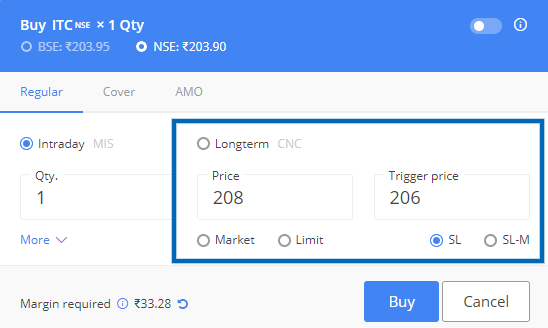
The stoploss (SL) order consists of two price components:
- The stoploss price is also referred to as the stoploss limit price.
- The stoploss trigger price is referred to as the trigger price.
Example scenario
- You place an SL (Stoploss - Limit) order for ITC.
- Once the stock price reaches ₹206, your order becomes active, triggering a limit order at ₹208 sent to the exchange.
- You will purchase the stock at either ₹208 or a lower price if sellers are available at that point.
A stoploss order is a passive order. The trigger price acts as a threshold, and your stoploss order becomes active only when the market price crosses this threshold, whether it is above or below the stoploss price.
A stoploss order is only valid for a trading day. If the exchange does not trigger your stoploss order during that day, it will automatically expire at the end of the trading session. To have an order that remains active across multiple trading sessions (up to 1 year) until the trigger condition is met, you can place a Good Till Triggered (GTT) order.